

By TechGono Editorial Team | Updated: January 13, 2026
For decades, Norway was the ultimate destination for international students because of one major perk: Tuition-Free Universities.
However, the rules have changed. To study in Norway today, students from outside the EU/EEA must now pay tuition fees ranging from $12,000 to $35,000 per year.
Does this mean the dream is over? Absolutely not.
Norway remains a global powerhouse in Technology, Renewable Energy, and Marine Engineering. The key difference in 2026 is that you can no longer rely on “free admission”—you need a strategy.
This guide breaks down the remaining Fully Funded Scholarships, the unique “PhD as a Job” system, and how to use Student Loans to bridge the gap if you don’t get a grant.
Table of Contents
1. The “Tuition Reality Check”: What You Need to Pay in 2026
Before you apply, you must verify your status on the Official Study in Norway Website.
- EU/EEA/Swiss Citizens: Education remains Tuition-Free at public universities.
- Non-EU/International Students: You must pay tuition fees.
- Bachelor’s Degrees: Approx. NOK 130,000 ($12,000) per year.
- Master’s Degrees: Approx. NOK 180,000 – 250,000 ($17,000 – $24,000) per year.
The Good News: PhD programs in Norway are exempt from tuition fees. In fact, doing a PhD in Norway is considered a full-time job with a high salary (approx. $45k–$50k/year).
2. Top Fully Funded Scholarships (The “Gold” List)
Since tuition is no longer free, these are the most competitive and valuable awards available in 2026.
A. Erasmus Mundus Joint Masters (Fully Funded)
This is the best option for Master’s students.
- How it works: You study in 2-3 different European countries (e.g., Semester 1 in Norway, Semester 2 in Spain).
- Coverage: 100% Tuition Fee Waiver, Monthly Stipend (~€1,400), and Travel Allowance.
- How to Apply: Search for programs in the Official Erasmus Mundus Catalogue. Look for courses partnered with NTNU or UiO.
B. The PhD “Salary” Scheme (Best for Research/Tech)
In Norway, a PhD candidate is not a “student”—they are an employee.
- Coverage: No tuition fees.
- Salary: You receive a monthly salary of approx NOK 45,000 – 52,000 ($4,200/month).
- Benefits: You get full worker rights, paid vacation, and healthcare.
- How to Apply: Do not apply to the “university admissions.” Apply to specific Job Vacancies here:
C. NORPART (Partner Universities)
If you are from a developing country, check if your local university has a partnership with a Norwegian institution under the NORPART Scheme. Students in these exchange programs often receive full funding and tuition waivers.
3. University-Specific Scholarships (Tech & Business)
Some universities have created their own scholarships to keep attracting international talent despite the new fees.
BI Norwegian Business School (Private)
BI has always charged tuition, so they have a mature scholarship system.
- BI Presidential Scholarship: Covers 100% of tuition + living stipend for top-tier candidates.
- Women in Finance & Tech: Specific grants for female students in STEM/Finance.
- Apply Here: BI Scholarship Info
Norwegian University of Science and Technology (NTNU)
As Norway’s premier Tech University, NTNU offers specific waivers and funding for PhDs in high-demand fields like:
- Cybersecurity & AI
- Marine Technology
- Sustainable Energy
4. The “Funding Gap”: Student Loans & Part-Time Work
(If you don’t get a full scholarship, use these options)
Option 1: No-Cosigner International Student Loans
In 2026, private lenders will support international students at top global universities.
- Providers: Prodigy Finance and MPOWER Financing.
- How it works: They lend based on your future earning potential (your post-grad salary), not your family’s assets. No collateral needed.
- Tech Focus: Students in STEM and MBA programs are most likely to be approved.
Option 2: Working in Norway
Norway has high wages, which help offset costs.
- Student Rights: You can work up to 20 hours per week during the semester and full-time during holidays.
- Hourly Wage: The typical student job pays NOK 170 – 220 ($16 – $21) per hour.
5. Cost of Living in Norway (2026 Breakdown)
Norway is expensive. You need to budget carefully. Here is where your money goes:
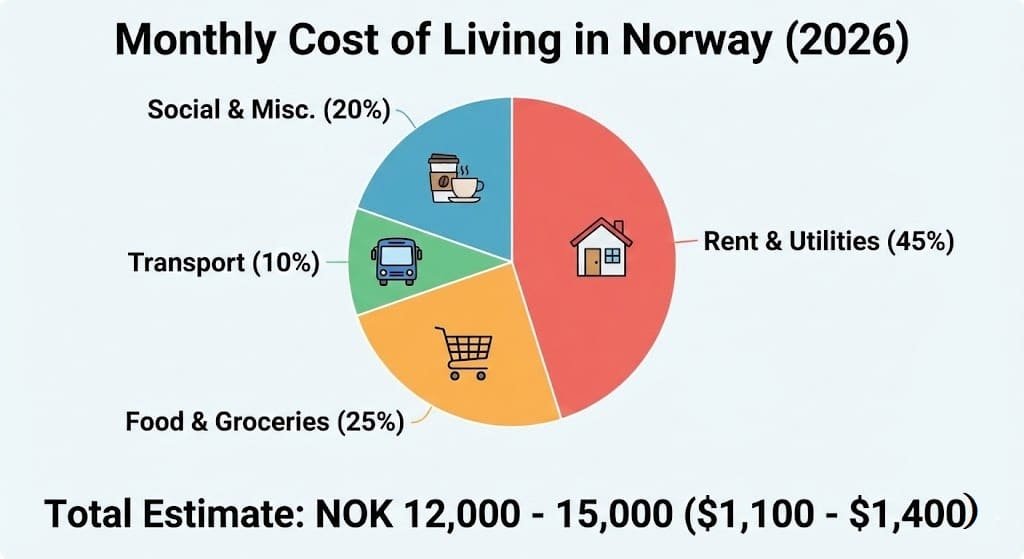
- Rent (Student Dorm): NOK 4,500 – 6,000
- Food: NOK 3,500
- Transport: NOK 500 (Student Pass)
- Total Monthly Need: Approx NOK 12,000 ($1,100).
Pro Tip: Exchange rates kill your budget. Do not use your home bank card. Check out our guide on the Best International Student Bank Accounts for 2026 to save on fees.
6. How to Apply: A Step-by-Step Guide
- Choose Your Program: Focus on “High Employability” degrees like Data Science or Engineering to ensure you can pay back any loans.
- Check for “Vacancies”: For PhDs, look at the “Work With Us” section of university websites, not the “Admissions” section.
- Apply for Admission: Deadlines are usually December 1st.
- Submit Financial Proof: To get a student visa, you must deposit funds (approx NOK 137,000) into a Norwegian bank account unless you have a scholarship letter. Check the UDI Visa Requirements for full details.
Frequently Asked Questions (FAQs)
Q: Is education totally free in Norway now?
No. Public universities now charge tuition fees to students from outside the EU/EEA/Switzerland. Only PhD programs remain tuition-free for all nationalities.
Q: Can I get a scholarship for a Bachelor’s degree?
It is very difficult. Most funding (like the PhD salary or Erasmus Mundus) is targeted at Master’s and Doctoral levels. Bachelor’s students should rely on family funding or loans.
Q: Is IELTS required?
Generally, yes. However, if you have a degree from an English-speaking country or can provide a “Medium of Instruction” certificate, some universities may waive this.
Ready to Apply?
Norway is challenging, but the rewards are massive. A degree from NTNU or UiO is a golden ticket to the European tech market.