
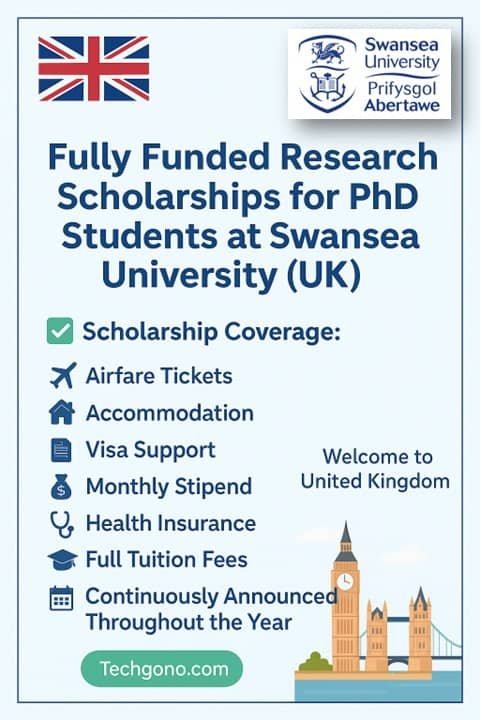
Pursuing a doctoral degree in the United Kingdom is a dream for many students, but the costs can be challenging without financial support. This is why the scholarships for PhD students at Swansea University stand out—these fully funded research opportunities allow talented individuals from all countries to complete a PhD in one of the UK’s most research-intensive and globally respected universities. These scholarships not only cover tuition fees but also provide generous stipends, research allowances, and full academic support, making them one of the most attractive PhD funding options in the UK.
Table of Contents
Swansea University
In recent years, Swansea University has emerged as a major destination for international researchers due to its high-quality research environment, world-class laboratory facilities, and globally recognized academic departments. Whether your research interests lie in engineering, health sciences, social sciences, law, computer science, marine biology, innovation, business management, or energy systems, the university provides exceptional pathways to fully funded PhD opportunities.
Fully Funded Research Scholarships for PhD Students at Swansea University
This detailed guide covers everything prospective applicants need to know about scholarships for PhD students at Swansea University, including eligibility requirements, funding coverage, application timelines, research areas, faculty structures, documentation details, and essential tips for building a competitive application.
Why Swansea University Is a Top Choice for Fully Funded PhD Research
Swansea University holds a strong reputation across the UK for its high research output and collaborative academic culture. It consistently ranks highly for research impact, employability, innovation, and international partnerships. These strengths contribute to the high demand for scholarships for PhD students at Swansea University, as the institution offers a supportive environment for developing advanced research skills and professional expertise.
Here are the key reasons why Swansea attracts thousands of PhD applicants worldwide every year:
1. A Strong Research Reputation
The university is recognized for groundbreaking research in engineering, materials science, energy systems, biomedical sciences, psychology, data science, law, and environmental sustainability. Many departments actively collaborate with industry leaders, government bodies, and international organizations.
2. World-Class Laboratories & Research Infrastructure
PhD students receive access to state-of-the-art laboratories, computing systems, innovation hubs, and research centers such as:
• The Computational Foundry
• The Energy Safety Research Institute
• The Welsh Institute of Cognitive Neuroscience
• Swansea University Medical School Research Centres
• The Centre for NanoHealth
These facilities make the scholarships for PhD students at Swansea University especially valuable.
3. Full Funding and Stipend Support
The university offers fully funded opportunities for international students. Each funding package normally includes:
• Full tuition fee coverage
• Annual tax-free stipend for living expenses
• Research and conference allowance
• Training and development support
• Access to academic workshops, networking events, and university research initiatives
4. Global Community and Support Services
With students from over 130 countries, Swansea ensures an inclusive environment where international researchers receive personalized guidance on academics, immigration, housing, healthcare, and academic writing.
5. Opportunities for International Collaboration
Many PhD programs include overseas research placements, industry internships, and conference participation, helping students build a strong global academic profile.
Types of Scholarships for PhD Students at Swansea University
Swansea University offers a wide range of fully funded research programs supported by different funding bodies. The exact scholarships vary yearly, but the categories remain consistent. Below are the most common opportunities available.

Swansea University Fully Funded PhD Scholarships
These are institutional scholarships that fully support PhD students across various departments. They cover full tuition fees and provide a generous stipend for 3–4 years.

UKRI & Research Council Scholarships
Many PhD scholarships at Swansea are funded through UK Research and Innovation (UKRI), including:
• EPSRC (Engineering and Physical Sciences Research Council)
• ESRC (Economic and Social Research Council)
• MRC (Medical Research Council)
• BBSRC (Biotechnology and Biological Sciences Research Council)
These are among the most competitive scholarships for PhD students at Swansea University due to their prestige and comprehensive funding.
College-Based Scholarships
Individual departments offer fully funded opportunities based on available research grants. These include:
• College of Engineering Scholarships
• School of Management Scholarships
• College of Science Scholarships
• Medicine and Health PhD funding
• Humanities and Social Sciences Scholarships
Industry-Funded PhD Scholarships
Many research projects are funded directly by industrial partners. These projects are ideal for students who want to conduct practical research that leads to real-world impact. Fields often include:
• Engineering
• Manufacturing
• Artificial intelligence
• Energy systems
• Healthcare technology
• Cyber security
Join the Facebook group “Fully Funded Scholarships in Italy.”

International & Regional Scholarship Schemes
Students from specific regions may qualify for international scholarship programs supported by external sponsors or foreign governments.
These types ensure that students researching scholarships for PhD students at Swansea University can find options suited to their field and academic background.
What the Scholarships Cover
One of the main reasons applicants target these scholarships for PhD students at Swansea University is the generous funding package. While exact amounts vary, the funding typically covers:
✔ Full Tuition Fees
Swansea University waives all tuition fees for the full length of the PhD program (3 or 3.5 years, sometimes 4).
✔ Annual Living Stipend
Students typically receive a tax-free stipend comparable to the UKRI rate, which usually ranges from £18,600 to £20,000 per year.
✔ Research Costs & Material Support
Scholarship packages often include budgets for laboratory materials, data collection, software, travel for field studies, and research equipment.
✔ Conference & Training Funding
Scholars may receive additional funding for:
• Presenting at international conferences
• Joining academic workshops
• Attending specialized training programs
✔ Access to University Facilities
This includes modern libraries, writing centers, sports facilities, and advanced laboratories.
✔ Professional Development Support
Doctoral students get training in:
• Academic writing
• Research methodologies
• Teaching skills
• Career preparation
These benefits make the scholarships for PhD students at Swansea University some of the most comprehensive in the UK.
Eligibility Criteria for Swansea University PhD Scholarships (Simplified & Expanded)
The eligibility conditions may vary from one scholarship to another, but the main requirements remain consistent. Below is an easy-to-understand breakdown.
Academic Qualifications
Applicants must hold:
• A first-class or upper second-class bachelor’s degree, OR
• A Master’s degree with strong academic performance
Certain fields, such as engineering or medical sciences, may require previous research experience or specific technical skills.
English Language Requirements
International students must provide proof of English proficiency. Accepted tests include:
• IELTS
• TOEFL
• PTE Academic
Some departments offer IELTS waivers if the applicant completed previous degrees in English.
Research Proposal or Project Statement
Applicants must submit a well-structured research proposal unless applying to a pre-defined project. The proposal should show:
• Clear problem statement
• Research objectives
• Methodology
• Academic relevance
• Alignment with existing research teams
Strong Academic Motivation
Students applying for scholarships for PhD students at Swansea University must demonstrate:
• Commitment to research
• Relevant academic achievements
• Strong writing and analytical skills
Reference Letters
Most applications require two academic references, preferably from supervisors familiar with your research or academic performance.
Field-Specific Requirements
Some departments may require:
• Programming skills
• Lab experience
• Professional certifications
• Fieldwork readiness
These simplified criteria help both new and experienced applicants understand whether they qualify for these scholarships.
Join the “DAAD Scholarships for All” Facebook group to unlock the doors to a brighter future through scholarship opportunities!

Major Research Areas at Swansea University
To help applicants choose the right program, here is an expanded section on Swansea’s strongest research fields. This detailed breakdown also boosts SEO for applicants searching by specific research area.
Engineering & Physical Sciences
Swansea is internationally recognized for its engineering faculties, especially:
• Aerospace Engineering
• Mechanical Engineering
• Materials Science
• Chemical Engineering
• Civil Engineering
• Systems Engineering
• Structural Integrity
The scholarships for PhD students at Swansea University in engineering are highly competitive due to industry collaborations.
Computer Science & Artificial Intelligence
Swansea’s Computational Foundry supports research in:
• Machine learning
• Cyber security
• Big data
• Software engineering
• Human–computer interaction
• Intelligent systems
Medical Sciences & Health Research
Swansea University Medical School is ranked among the UK’s top institutions. Areas include:
• Public health
• Clinical sciences
• Genetics
• Bioinformatics
• Nanomedicine
• Healthcare technology
• Medical imaging
Business, Economics & Management
The School of Management offers PhD research in:
• Finance
• Supply chain management
• Innovation
• Entrepreneurship
• International business
• Marketing analytics
Humanities & Social Sciences
Popular research fields include:
• Law
• Politics
• Gender studies
• International relations
• Education
• Social policy
• Sociology
Environmental & Marine Sciences
Swansea’s coastal location supports advanced research in:
• Marine biology
• Climate science
• Renewable energy
• Coastal engineering
• Environmental sustainability
These research strengths help applicants align their proposals effectively when applying for PhD scholarships at Swansea University.
Full Application Process (Step-by-Step Guide)
Applying for PhD scholarships at Swansea University involves several steps. This expanded guide provides clarity for both new and experienced researchers.
Step 1: Explore Available PhD Projects
Applicants should first browse Swansea’s list of funded PhD projects. These listings are regularly updated and provide essential details like:
• Project description
• Supervisor name
• Required qualifications
• Funding details
Step 2: Prepare a Strong CV
Your academic CV should include:
• Research experience
• Publications (if any)
• Skills relevant to your chosen field
• Academic achievements
• Professional experience, if applicable
Step 3: Draft a High-Quality Research Proposal
If the scholarship requires an original proposal, it must include:
• Title
• Background and rationale
• Research aim and questions
• Proposed methods
• Expected results
• Timeline
A compelling proposal significantly strengthens your chances of earning scholarships for PhD students at Swansea University.
Step 4: Contact a Supervisor
Not always mandatory, but highly recommended. Contacting potential supervisors shows initiative and helps:
• Clarify project expectations
• Align your research interests
• Improve your proposal
Step 5: Submit the Online Application
Applicants must fill out the Swansea University online application form. Common application sections include:
• Personal details
• Academic history
• Research proposal upload
• Reference contact information
Step 6: Upload Supporting Documents
This step requires attaching:
• CV
• Transcripts
• Degree certificates
• Proof of English proficiency
• Passport copy
• Research proposal
• Reference letters
• Personal statement
All documents must be clear and in English (or include certified translations).
Step 7: Attend an Interview
Shortlisted candidates are usually invited to an interview. The interview may include:
• Research discussion
• Academic background questions
• Motivation for choosing Swansea
Step 8: Receive Offer Letter
Successful candidates receive a formal scholarship offer detailing:
- Funding duration
- Stipend amount
- Conditions of award
- Enrollment instructions
These detailed steps ensure applicants fully understand how to secure scholarships for PhD students at Swansea University.
Required Documents
Students applying for PhD scholarships should prepare the following documents:
- Academic CV
- Bachelor’s degree certificate
- Master’s degree certificate (optional but preferred)
- Full academic transcripts
- Research proposal or project statement
- English language test score
- Two academic recommendation letters
- Personal statement
- Valid passport
- Portfolio (for relevant fields like design/architecture)
- Evidence of publications or academic papers (optional)
- Proof of work experience (if required)
- Preparing these documents early increases the chances of meeting scholarship deadlines.
Tips to Increase Your Chances of Winning Scholarships at Swansea
Here are expert-level strategies to help applicants strengthen their applications.
- Begin Preparing Early
Strong proposals and references require early planning. - Customize Each Application
Tailor your research proposal to the specific project or supervisor. - Demonstrate Academic Excellence
Highlight awards, research roles, or publications. - Show Alignment With the University
Make clear why Swansea is the right place for your research goals. - Strong Communication Skills
Clear writing and organization reflect well on your application. - Highlight Technical Skills
Especially important for STEM fields.
Important Dates & Deadlines
Various scholarships are announced throughout the year.
FAQs
- Are scholarships for PhD students at Swansea University fully funded?
Yes, most scholarships cover full tuition fees and provide generous stipends. - Can international students apply?
Yes — applicants from all countries are welcome. - Do I need a Master’s degree?
A Master’s is not always required, but it strengthens your application significantly. - What is the duration of a PhD scholarship?
Most run for 3–4 years. - Can I work part-time during my PhD?
Yes, students can work within UK visa limitations. - Is IELTS required?
Many applicants need IELTS, though some may qualify for waivers. - Do I need a research proposal?
Yes, unless applying to a predefined funded project. - When should I apply?
Applications open year-round, but early submission is highly recommended.
Official Website (At End as Requested)
Visit the official Swansea University page for updated scholarship information:
Research Scholarships – Swansea University

More Scholarships?
United Nations Volunteers Program Fully Funded
University of Brighton Scholarships
King Abdullah University Scholarship